


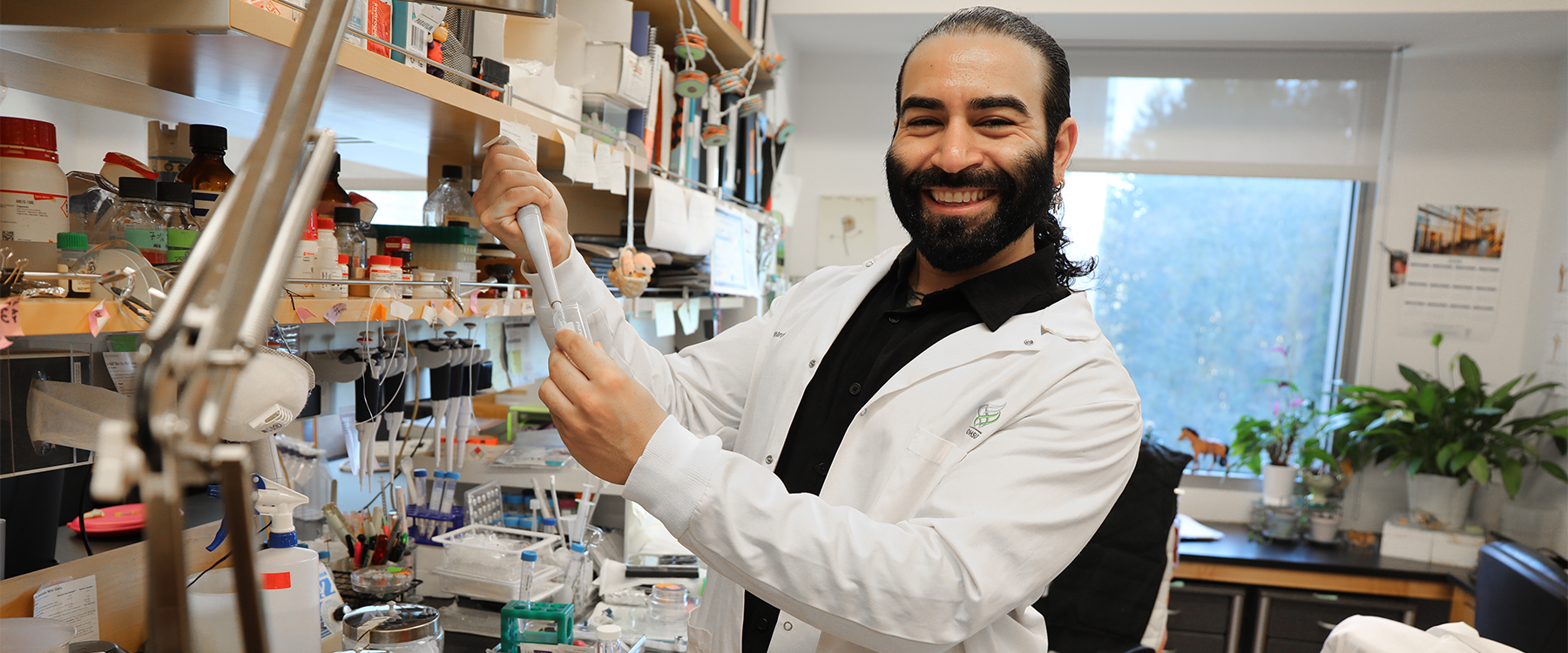
Explain It! is a video series that spotlights the fascinating and impactful research taking place at OHSU.

By Josh Friesen
Glaucoma is one of the leading causes of irreversible blindness.
Around the world, approximately 95 million people live with glaucoma, and it is expected to affect 111.8 million by 2040. About 14% of individuals with glaucoma lose vision in one eye, and around 5% experience blindness in both eyes.
There is no cure for glaucoma. Eye drops remain the most common way to slow its progression. Alireza Karimi, Ph.D., assistant professor of ophthalmology and biomedical engineering in the Oregon Health & Science University School of Medicine and Casey Eye Institute, hopes to drastically change that.
“I hope to fully replace the system we have for controlling glaucoma — which is mostly eyedrops — and move that to a longer-term treatment,” he said. “We’re trying to move this traditional treatment pathway to a more advanced, one-time therapy.”

Glaucoma is an eye disease that damages the optic nerve, typically due to increased eye pressure. In a healthy eye, fluid flows and drains freely. However, if the eye makes too much fluid or isn’t able to drain properly, the pressure gradually builds, squeezing the optic nerve and damaging the vital fibers inside it.
Traditional glaucoma treatment can help decrease eye pressure, but it doesn’t address the mechanism that causes the elevated pressure in the first place. Karimi’s research aims to restore the eye’s ability to control pressure on its own.

“If the optic nerve gets damaged, it’s permanent. You can’t reverse it,” Karimi said. “That’s why my research attacks the main risk factor: the pressure. Hopefully we can control that eye pressure, control the optic nerve damage and help a lot of patients not get blind.”
Karimi’s research leverages computer modeling and biomechanics to understand more about the tissues and cells in the eye associated with fluid drainage and how stiffness in those tissues and cells influences the eye’s drainage system. From these findings, Karimi’s lab developed a model that mimics the eye’s drainage system, enabling a wealth of new scientific opportunities that could give way to revolutionary new therapies.
“We’ve made significant advancements over the last two years,” Karimi said. “With OHSU’s support and our facilities and the environment we have here, we’re moving faster than expected.”
“It’s really my honor to be a part of OHSU and a part of Casey,” Karimi added. “We have such an amazing environment. We connect clinicians with scientists as much as we can, so collaborations happen so quick.”

Discovery
Explain It! Ahmed Raslan, M.D., FAANS
Explain It! showcases the fascinating, impactful research at OHSU. Ahmed Raslan, M.D., discusses redrawing the functional atlas of the brain.
Discovery
Explain It! Jonah Sacha, Ph.D.
Explain It! showcases the fascinating, impactful research at OHSU. Jonah Sacha discusses why he believes we will cure HIV within our lifetimes.

Patient Care
Casey Eye patient sets up fellowship after OHSU saves eyesight
Joe Whittinghill is paying it forward after the OHSU Casey Eye Institute found the cause behind his gradual blindness and saved his eyesight.