


By Darby Kendall
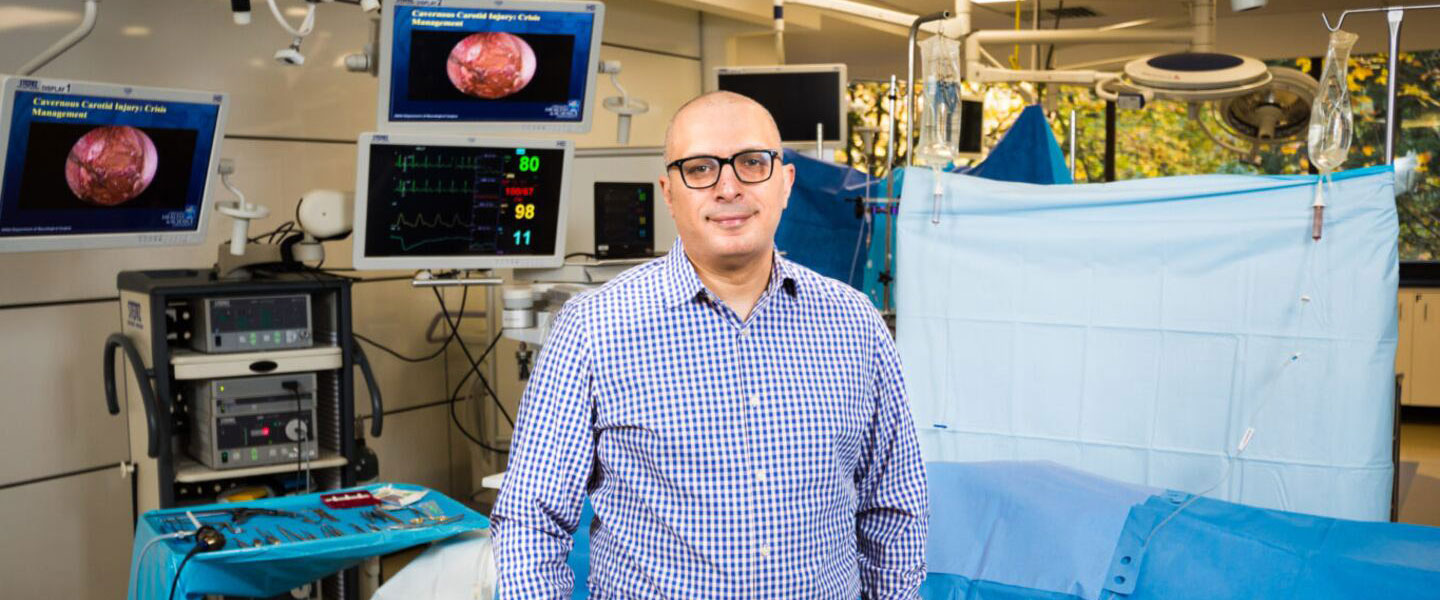
Ahmed Raslan, M.D., FAANS, John Raaf Chair of Neurosciences, is a neurosurgeon at OHSU who cares for adult patients with epilepsy, brain tumors and movement disorders. He works in the emerging field of bioelectronic medicine, where cutting-edge devices interface directly with the nervous system to treat previously untreatable conditions.
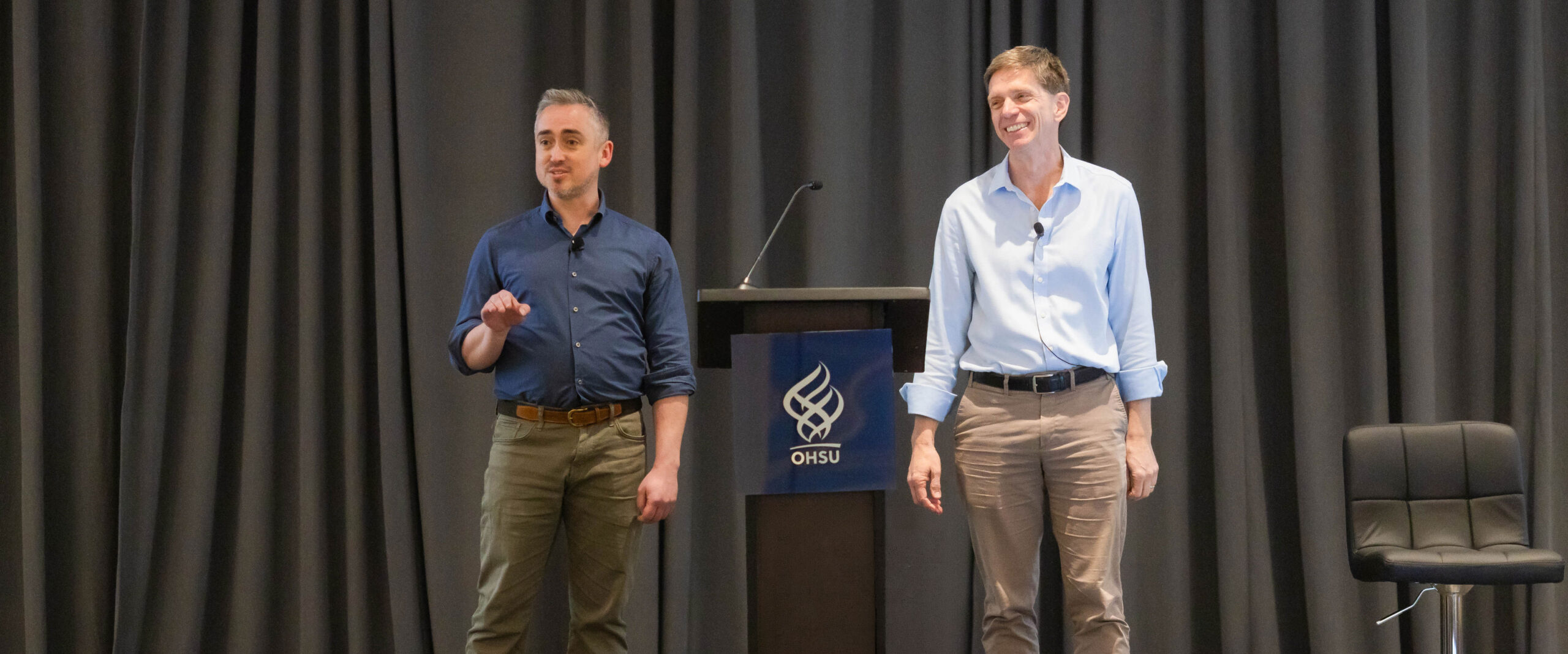
Here are some highlights from Raslan speaking at a recent conference on the brain, epilepsy treatment, and the future of tracking and preventing seizures.
Transcript
So, I’m going to talk to you a little bit about the language we all speak, and everyone speaks this language, but you can’t hear it. It’s the language that allows you to move your hand, allows you to recognize a face, allows you to think of the future, or even fall in love. We’ve been trying to kind of read this language for human history.
Dr. Ahmed Raslan is a neurosurgeon at OHSU who cares for adult patients with epilepsy, brain tumors and movement disorders. He works in the emerging field of bioelectronic medicine, where cutting-edge devices interface directly with the nervous system to treat previously untreatable conditions. Here are some highlights from Dr. Raslan speaking at a recent conference on the brain, epilepsy treatment, and the future of tracking and preventing seizures.
We are trying to map the galaxy with a magnifying glass. We miss a lot of things. We see kind of flashes of light, we see faraway stars, but we cannot see the actual actions. And we need to start to match the complexity of the organ we want to seek to heal with a tool that matches that complexity, so we can see the activities that lead to problems as well as lead to what makes us human.
This is Bill, and when I met Bill in 2014, he had been having seizures for eight years. He lost his front tooth, he cannot drive, and he can’t work. He gave up on his dreams not because he doesn’t have the intention or the motivation — it’s because his brain wouldn’t allow him to do so. And the problem was the unpredictability. He didn’t know at what time those seizures would come along or would impact him in ways that might be life threatening. We had to treat him, and we implanted this device, which I’m going to get back to you at the end, and I’ll tell you what happened to Bill.
So in the United States, there are 3 million patients with epilepsy. Two million of them will respond to medication. One million will not respond to medication, and this 1 million could benefit from surgery. How do we determine patients that would benefit from surgery? We have to put them in a specialized unit called the epilepsy monitoring unit. We have to watch them like a hawk with a camera. OHSU has the vastest number of EMU beds in the state, more than everybody else combined. You know how many beds we have? Eight. So that limits the throughput of how many patients could be treated or diagnosed.
We want to do this at home. We want to implant those and send patients home, so we can monitor them for longer and in their naturalized setting. You know, the longest I was able to convince any one patient to stay in the hospital was 21 days. They are approved by the FDA to be up to 30 days, but it’s almost impossible to keep anyone that long. Now, does the short period matter? Yes, it matters because we know that in four out of 10 patients with epilepsy, if you have more than one area that causes seizures, the second area will not manifest itself until 14 days, and the longer you look, the longer you find.
And the only way to unlock this is we create what’s called an ambulatory SCG system. That’s just a big word. It means you have to implant them, send them home, and let the wireless transmission happen and send the information to the clouds. That’s a completely different ecosystem than what we have today, and if that works, we can start looking at other things other than epilepsy, things that change over a slow pace — depression, for example, OCD, Alzheimer, many many things. So, we can solve the bottleneck of epilepsy, but we can also solve a bigger problem when we do this.
Let’s go back to Bill. So, this device reads out his brain activity at the beginning, a lot of activity, and it stopped. The reason it stopped was because when we read out his brain activity, we discovered that 95% of his seizure activity comes from one part, and 5% comes from a different part which is not symptomatic. So we chose to remove that one part and left the sensor to read out the brain activity after removal. And he became seizure-free. What happened when he became seizure-free? He went back to law school and he’s a practicing lawyer. We want to do this for everyone. We want to achieve Bill’s outcome for everyone. So now we want to move from what we cannot do to what we will do, help us define the resolution of the future, and by using this technology, we now can restore what makes us human.
Discovery
Discovery
Discovery