


By Darby Kendall
OHSU Doernbecher Children’s Hospital’s multidisciplinary teams — including fetal medicine, surgery, neonatal intensive care unit (NICU) and subspecialty care — collaborate to provide seamless, family-centered care across a child’s lifetime. The Doernbecher Fetal Care Program is the only one of its kind in the region that keeps pregnant patients and their babies in one place through diagnosis, treatment, delivery and recovery.
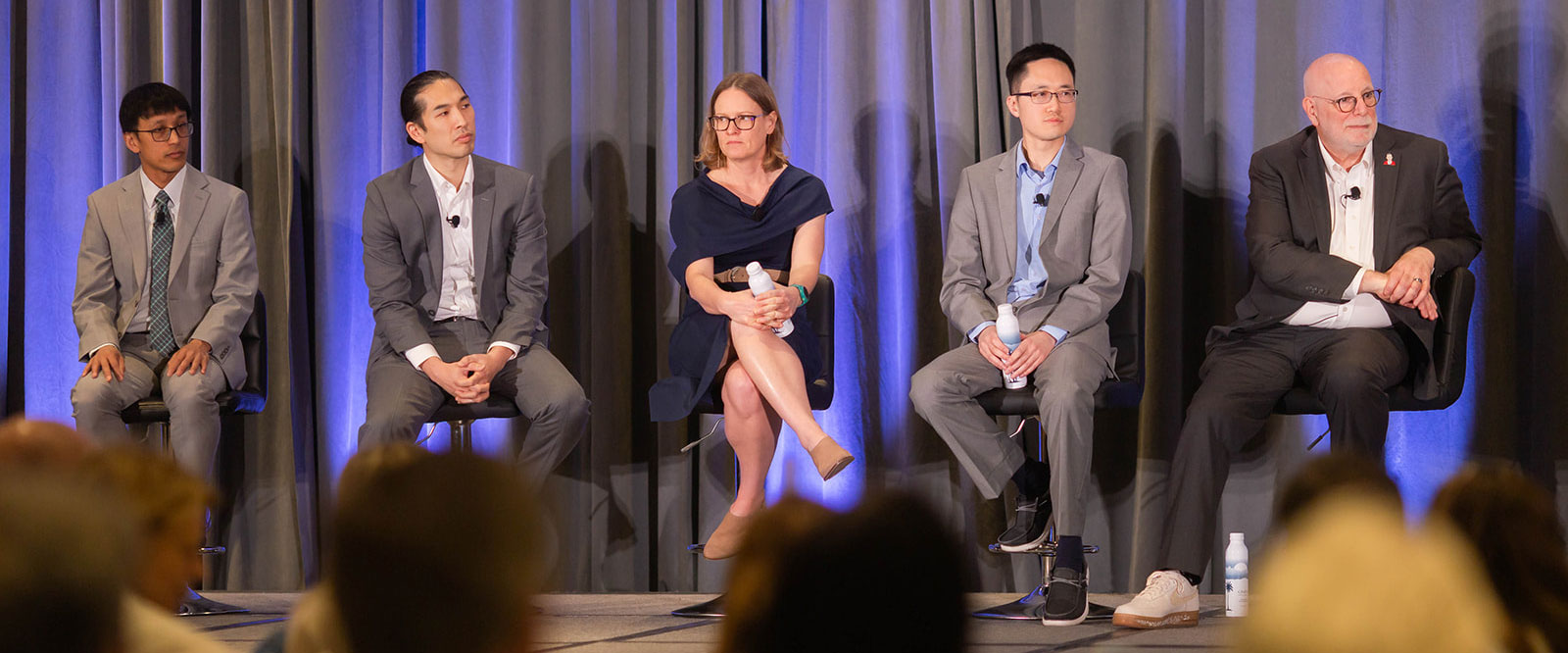
Here are some highlights of leaders and experts from Doernbecher speaking at a recent conference on the integrative medicine across the children’s hospital. The featured speakers include Dana Braner, M.D., FAAP, FCCM, Physician-in-Chief at OHSU Doernbecher and Credit Unions for Kids Chair in Pediatrics; Andrew Chon, M.D., Fetal Surgery Program Co-Director; Henry Lin, M.D., M.B.A., Professor of Pediatrics; Raphael Sun, M.D., FACS, FAAP, Fetal Surgery Program Co-Director; and Jamie B. Warren, M.D., M.P.H., FAAP, Professor of Pediatrics.
Transcript
Dr. Braner: Only in pediatrics can you save a lifetime. One of the best examples of this is our Doernbecher Fetal Therapy Clinic, and today we have four amazing physicians from the clinic representing the entire team. We’re going to take you through the story of one of our patients in that clinic. It is absolutely my honor to introduce you to Andrew Chon.
Dr. Chon: Our Fetal Care Center is a very unique collaboration between the Department of OBGYN as well as Doernbecher Children’s Hospital. We’d like to take you on a journey today with one of our prior patients, Jean. She, like many other patients, were going through the routine pregnancy until 33 weeks, where she was told by a high-risk obstetrician that there was something very concerning on the ultrasound that basically implies that there’s a distal blockage or functional issue with the intestine moving the fluid throughout the intestinal tract. And this can make the baby not just sick after delivery, but during the pregnancy. So, within 24 hours, she was brought to OHSU by transport. We were able to stabilize the mom, and upon stabilization, confirm the diagnosis. Certainly, it was still a stressful time, but some of those fears and anxieties were put to rest because she happened to be in the right place at the right time.
When it was time for Jean to deliver, she delivered on our Labor and Delivery Unit, and the baby was transported to our NICU. Her baby, Samuel, got thorough care in our NICU. I can’t emphasize enough how important it is for a patient to be able to deliver and stay on that hospital grounds and be next to her baby. You can imagine how stressful it would be if you went through such a high-risk pregnancy, delivered, and the baby was transported to a different city, or potentially even a different state. At our fetal center, we’re proud to say that everything is integrated on a single campus, including the NICU and our pediatric subspecialties. So, with that, I’d like to pass it off to Dr. Warren to tell you about the NICU.
Dr. Warren: Let me first tell you who we take care of in the NICU. The NICU is a place that any baby who needs additional medical support beyond what’s needed in a normal delivery room or in a normal newborn nursery comes. So we may take care of a baby just for a few hours while he figures out his breathing, or while she regulates her blood sugar, or we may take care of a baby for weeks to months while he prepares for and undergoes a lifesaving surgery, like Samuel, who we’re talking about today, or while she grows from being a less than one pound preemie into a healthy infant who’s ready to go home with her family.
60 years ago, we didn’t have anywhere near the skills and equipment and knowledge that we have today to take care of premature babies. In fact, 60 years ago, a baby born at 34 weeks gestation, just six weeks before the due date, may not have the ability to survive. Now, just within the last few years, the Doernbecher NICU has become one of a handful of NICUs in the Pacific Northwest who’s able to take care of babies born at 22 weeks gestation. That’s where I want to come back to Samuel’s story. We knew that Samuel was going to be born early, and we knew that he was going to need surgery, and with those two things, we knew that Samuel was going to be part of our community for weeks, if not months. I’m going to turn it over to Dr. Raphael Sun, who’s one of our pediatric surgeons, to tell you what happened next with Samuel.
Dr. Sun: What I love most about my job is I get to meet my patients before they’re born. Many mothers come to the clinic, they’re scared, they’re overwhelmed, they just got an unexpected diagnosis of their unborn baby, and they don’t know what to do. Their world has just flipped upside down, but that’s where we come in. We can guide them. So that’s exactly what happened with Samuel and his care during pregnancy. He was diagnosed with what we call a meconium pseudocyst. It’s extremely rare. In simple terms, it means that there was a hole in the intestine, and in this case, it was because of that intestinal atresia Dr. Chong talked about. So when Samuel was born, he was tiny, he was premature. His belly was enormous. It was so large that it was pushing up against his lungs, making it really challenging to breathe. In these types of situations, we don’t rush into surgery. Inside the abdomen, it’s extremely inflamed. It’s what I call a hostile abdomen. The tissues inside the abdomen are inflamed, friable, fragile, and we can actually do more harm than good. So, instead, we waited, we supported him, stabilized him, and our colleagues from Interventional Radiology were able to put in a drain to decompress the cyst, allowing him to be able to breathe better.
So at three months of age, I took him to the OR. I did an exploratory laparotomy, which means I opened up his belly and attempted to take out this cyst, and then I gave him a feeding tube, so that he can use his gut for the first time in his life. But at the end of the day, he has short gut syndrome. What does that mean? It means he doesn’t have the normal length of intestine of an average child. He was left with only about 50 to 60 centimeters of bowel. So the next year was going to be a long, rocky course. He had multiple procedures, many challenges. Despite the rocky road, his family did not give up, and neither did our team. And today Samuel is thriving. He’s jumping, he’s climbing, he’s playing like any other normal child. But his journey doesn’t end here. He still has a long way to go, because he still has that feeding tube, he still has that central line to give him nutrition through the veins. And that’s because he needs continuity of care, and he’s going to get that through the Doernbecher GI program, which Dr. Henry Lin will talk more about.
Dr. Lin: For Samuel, as Dr. Sun alluded to, one of the first things and goals that they identified was good nutrition. So, how do we do that? Well, as you can imagine, someone with short gut syndrome, or someone who’s missing parts of the small intestine, which is important to help you digest and absorb food, that can be difficult, and Samuel needed that nutrition delivered directly to the blood through an IV, using a more stable line that can create a lot of potential challenges. There’s a risk of infection. There’s a need for routine monitoring of the blood for nutrient and electrolyte levels to make sure that we can deliver this nutrition in a safe manner. Historically, this meant that children who received this type of supplemental nutrition needed to receive this in the hospital. Now, with advances in medicine, our home TPN team, that’s the team that takes care of this supplemental nutrition, we can help support Samuel to receive this nutrition outside of the hospital, where he can be at home with his friends and family. Ultimately, the goal is not only for the child to feel good and feel cared for, but also for the child and family to feel confident about the medical care they receive, and that is what we all aim to do here at Doernbecher.
Dr. Braner: What you have heard is literally what goes on at your children’s hospital every single day of the week. I like to call it the world-class children’s hospital that’s just up the street, a team of people dedicated to one thing, dedicated to the most important person in any room, the child and the family.

Community | Patient Care
Patient Care

Patient Care