


By Darby Kendall
A cursory trip to the emergency room in 2002 changed the life of Ramsey Selbak, M.D. ’17, forever. In one fell swoop, a large, cancerous mass was found in the then-15-year-old’s chest, and the seed for his future career in emergency medicine was planted.
Chest pain is a relatively common complaint amongst growing, active teenagers. As a high school athlete, Selbak was used to aches and soreness, but that evening the pain was unusually high, so he went to his local emergency room in Salem, Oregon, just to make sure things were alright.
“I was super active at the time, playing three sports and training for tennis tournaments. I thought that I overdid it and ended up in the ER one night with weird shoulder and chest pain,” Selbak said. “Being on the other end now as an ER doctor, a 15-year-old with chest pain, that could be nothing. My chest X-ray looked a little goofy, but not overly goofy. I remember talking to the ER doc about it, and he said, ‘Your mediastinum looked very subtly wide.’ So, we did a CT, and I had a big mass in my chest.”
Thanks to his ER doctor’s extra attention, Selbak was referred to OHSU Doernbecher Children’s Hospital, where the mass was removed within the week. Initially, doctors thought the mass wasn’t malignant, but after it was sent out for testing, Selbak’s unexpected diagnosis came in.
“Lo and behold, to everybody’s surprise, it was Hodgkin lymphoma. I came back to Doernbecher, met with the surgeon, and they zipped me upstairs,” Selbak remembered. “I got a treatment plan that same day with Dr. Gregory Thomas, who’s now retired. Dr. Stephen Roberts was also there; he was in fellowship. They told me, ‘The surgery looks like they got the whole mass out, but we can’t guarantee it.’ I had six months of chemo, and then follow-up, and I have been good ever since.”
Selbak’s time at Doernbecher was unforeseen and challenging, but he made the best of his days there. Stephen Roberts, M.D., Robert C. Neerhout Chair of Pediatric Oncology, was a fellow at the time Selbak was in treatment, and the two developed a friendly relationship.
“Honestly, Doernbecher became a home away from home. I wouldn’t say it was fun, because it was a hard experience, but it was as fun as going through that could be,” Selbak said. “Dr. Roberts was amazing. He was just so easy to talk to and down to earth. The whole time, the whole team was so positive, so uplifting. I always felt like I was in this world-class hospital with doctors that knew what they were doing but were also very human. I knew that I was in good hands up there, and I think my whole family felt that way.”
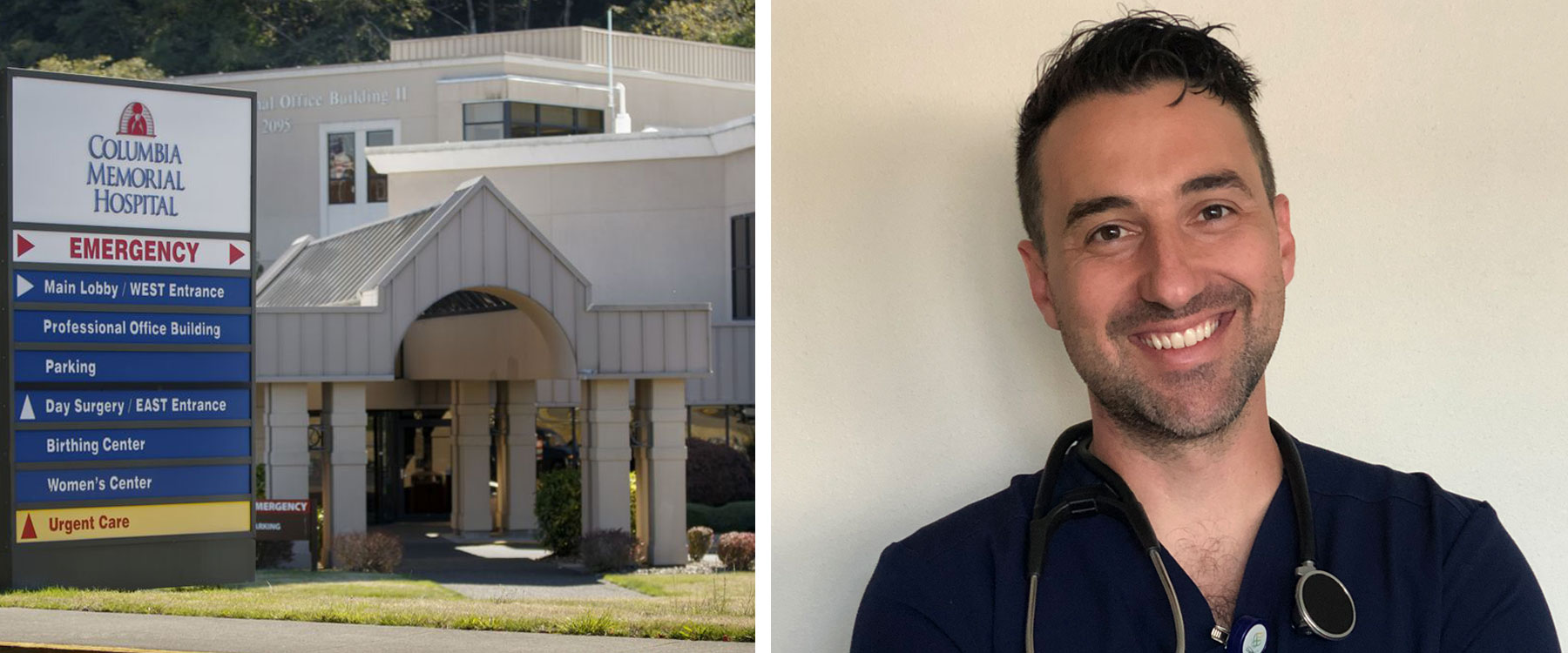
Now, two decades later, Selbak is an OHSU emergency physician and associate medical director staffed at Columbia Memorial Hospital in Astoria, Oregon. Inspired by his care team at Doernbecher and the ER doctor in Salem who took the extra time to help him, Selbak decided to dive back into the world of health care.
“Dr. Roberts was kind enough when I was in high school to let me come do a shadow shift with him, which was really cool,” Selbak said. “Ultimately, I think what I went through made me interested in medicine. Having had that experience and thinking about being able to help people was really my motivation for being here. My path to medicine started in the ER. I had an ER doctor who I felt like took a little bit of extra time with me and didn’t dismiss my complaint in a way that I think it easily could have been.”
Since entering medical school, the personal and professional have mixed in extraordinary ways for Selbak. He attended OHSU for his M.D. and completed part of his residency at Doernbecher, re-walking those same halls he did as a teenager.
“It’s very surreal having done all my medical training at OHSU. Dr. Thomas taught a blood course when I was in med school. Having my doctor be my professor, it was cool that I could talk to him and learn from him and be on the other side of it,” Selbak said. “There are times when, because you go through something like that as a kid and end up going into medicine, it can be a superpower and a curse at the same time. My ability to connect with patients that are going through hard times is somewhat unique. It also can be a reflection of my own experience, which can be challenging. Overall, having had my experience at Doernbecher, which was wildly positive, and then having the chance to do all my training there was really cool.”
Selbak’s unique ability to connect to and empathize with patients he sees in the ER continues to fuel his passion for the field. The kindness shown to him by Roberts and Thomas carries into his work today, and he hopes to leave similar impressions on those he treats in Astoria.
“I took care of a kid when I was a resident at Doernbecher who presented similarly to me and had Hodgkin lymphoma. It was almost the same story; she was 15 and had also had an X-ray. It was super surreal,” Selbak said. “I almost never talked to patients about my story, but I did share it with her mom because they were kind of freaked out and nervous, and I wanted to reassure them. It was one of those moments where I thought, ‘Oh, this is interesting. Maybe this is why I went down this path.’”
Students & Alumni
Patient Care
Students & Alumni