


By Josh Friesen
Lengthy hospital stays can be disruptive, uncomfortable and frightening for children.
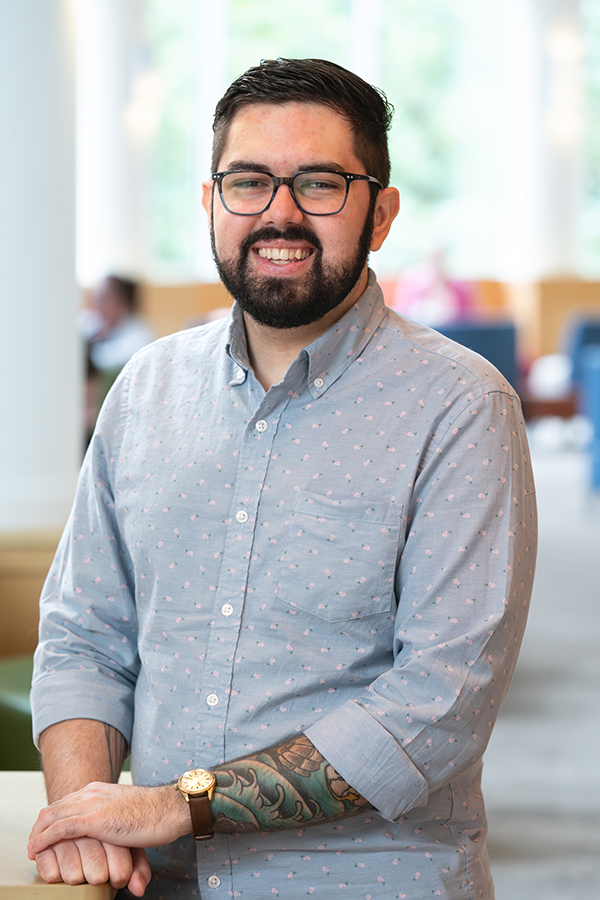
Justin Wooley, patient gaming specialist in the Child Life Therapy Program at OHSU Doernbecher Children’s Hospital, uses the therapeutic power of video games to help make young patients’ experiences less intimidating and more enjoyable.
The Child Life Therapy Program offers a variety of activities for Doernbecher patients that include art, music, books and toys, among other things. Extra Life, a fundraising program of Children’s Miracle Network Hospitals in which members of the gaming community play games and raise funds for children’s health, supports the patient gaming specialist position at Doernbecher.
We caught up with Wooley to learn a little about his role, how he came to Doernbecher, how video games help young patients during their hospital stays, and how Extra Life and the Children’s Miracle Network Hospitals help make it all happen.
The responses in this Q&A have been lightly edited for length and clarity.
Can you tell us a little bit about you, how you came to Doernbecher and — maybe most importantly — what your favorite video game is?
“I ended up here kind of through a stroke of luck. I’m from Texas. I did banking for a number of years and realized I wasn’t really enjoying that. I used to be a medic in the U.S. Army, and I used some of my veteran benefits to go to coding school to learn how to do JavaScript and other nerdy coding things. That was right around the time when every software company you’ve ever heard of started laying off developers — we saw, like, 20% workforce reductions from places like Meta and Google and the like. So, I started looking for different roles.
I happened to know one of the Child Life specialists up here at Doernbecher. She was from Texas, and she hit me up one day and said, ‘Hey, have you seen we have this gaming job opening up? I think it’s perfect for you.’ I was already playing way too many video games, right? I had a health care background from the military. I had already raised money in my own free time on the side for Extra Life because my sister had leukemia. So, I was like, ‘Oh, this is a slam dunk job.’ I applied, got it and then moved up here from Dallas. I’ve been here now about a year and a half, and I love it. It’s great.
And as for games that I play in my free time, probably the game that has clocked the most hours for me in my life is “World of Warcraft.” So, that lets you know the scale of how into the nerdom I am. I will also go play “Dungeons and Dragons” with my friends or “Magic the Gathering,” so not only video games — I’m just nerd culture centric.”
“I’ll go into patient rooms, sit down with kids and just talk with them about what they like to do. It helps us as a team connect with our patients and meet them where they are.”
Justin Wooley
What does this role entail? What does your day-to-day look like?
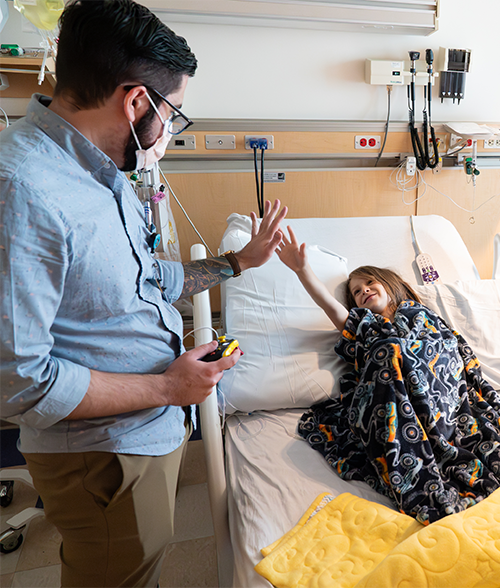
On an average day, I’ll do anything from playing games bedside with patients, to setting up new video game systems or repairing existing ones. I’ll get calls from patients that the picture isn’t on the screen, so I’ll come in and troubleshoot. We’ll run events, too. For instance, March 10, MAR10, that’s Mario Day in the gaming world. We set up a projector in a playroom and a Nintendo Switch, and we have little printout Mario mustaches kids can wear, and we do “Mario Kart” time trials. We invite the nurses and doctors come compete with the kids too, because, of course, kids love to see their nurses or doctors getting smoked in “Mario Kart.”
There are countless studies on the power of play in a hospital and how it helps with recovery, mental health and anxiety. A lot of people kind of boil the job down to, ‘Oh, you get to play video games all day — that’s cool.’ And that is part of the job. I do play games a reasonable amount of the day. But I’ll also go into patient rooms, sit down with kids and just talk with them about what they like to do. It helps us as a team connect with our patients and meet them where they are. Talking about “Pokémon” can help offset some of the anxiety of their stay. I play a lot of “Minecraft” with younger patients who want to go around and knock trees down. That’s it. And if that brings them joy and happiness, that’s what I want to do, too. So we’ll just go around and knock trees down, and then I build a house and they explode it with dynamite and it’s hilarious, but that’s what an average kind of session looks like. I just kind of let them choose.”
Speak to the therapeutic power of videos games. How can they bring joy, normalcy and distraction for young patients, some of whom are at Doernbecher for serious or complex health reasons?
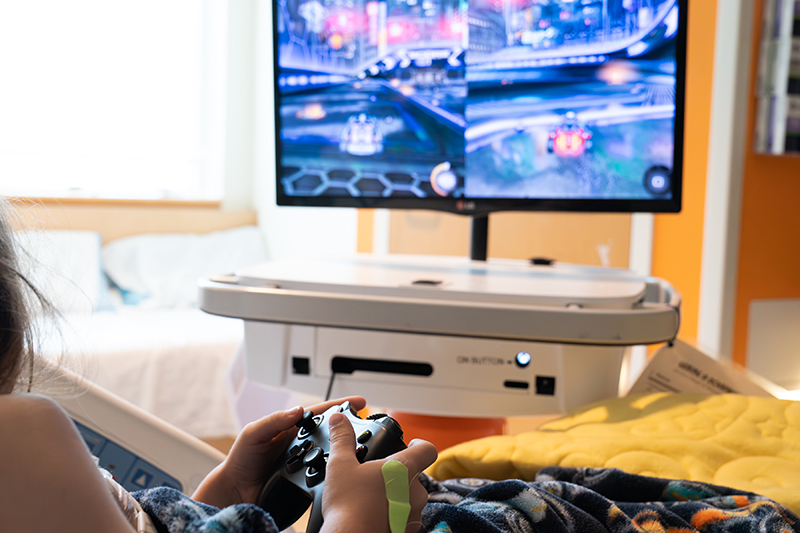
“I often feel that the gaming aspect of their stay is one of the places where they still have control and choice in a place where they are asked to give up their control. Sometimes, you don’t get to choose things like when you go to sleep or what you eat. You might have to fast for surgery. But you can pick what map we race on in “Mario Kart.” You can choose if we play “Madden” or “NBA 2K.” So, it gives that little bit of control back, which is great for coping and normalization.
Also, just the fact that someone speaks their language. I talk to children not just about video games. I’ll come in and they’ll be watching “Yu-Gi-Oh,” and I’ll ask, ‘Oh cool, who is your favorite character? Mine is Seto Kaiba,” and they’re like, ‘Woah, you know “Yu-Gi-Oh?”’ Seeing someone who’s at their level and who can speak about these things helps pep kids up. Kids who come in and are super reserved and in their shell, I’ll meet with them and ask about “Fortnite” or “Minecraft,” and you can just see them brighten up.”
Can you speak to the impact Extra Life and Children’s Miracle Network Hospitals has had on supporting your role, the Child Life Therapy Program and children’s health in general?
“Yeah, so like I mentioned, my youngest sister was diagnosed with leukemia when I was a freshman in high school. She went through chemo, and she’s fine now, but it was quite the experience and I felt like I wanted to do something after I went through that with her and my family. So I raised money for Extra Life on my own. I posted on Facebook and Instagram that I’d be doing an Extra Life stream. Extra Life’s schtick is people do 24-hour streams and others donate as they’re playing — kind of like a walkathon but for gamers. And I’m definitely not going to go run a 10k, but I will play “Rocket League” for 24 hours. So that’s what I did. The gaming community is so generous. They’ve raised millions of dollars doing this, and it’s really something to see.
And then Extra Life supporting this position and the Child Life program, it means everything. It’s no secret hospitals are going through big changes with budget problems and things coming down from at the federal level that reach us. We see different levels of funding being appropriated and cut, and that’s hard. It’s hard to get these kinds of supportive services in a hospital setting when you have somebody looking to make budget cuts. So, if we didn’t have Extra Life coming in and helping with this position, I’m not positive it would be here.
To my knowledge, the large majority of gaming specialists in children’s hospitals in the United States are charity-funded or grant-funded. That’s grown in the last year or so from around 55 to 70. The fact that there are 70 in the United States now is very validating. Child Life kind of went through a similar thing where it didn’t exist and then it did. The more hospitals that pick it up and the more charities that come in and start assisting, it gives it more validity, and then it grows and grows. Now, Child Life is an integral part of a hospital. If you were building out a pediatric hospital, you would include Child Life. It feels like the trajectory is going that way with gaming specialists because it is sort of that middle ground between IT and patient care.”
Patient Care
Patient Care

Community | Patient Care