



Explain It! is a video series that spotlights the fascinating and impactful research taking place at OHSU.

By Josh Friesen
The human brain is the most complex system found in nature that we know of.
Inside the brain, tens of billions of neurons form connections via trillions of synapses. An intricate hierarchy of genes, proteins, cells and neural circuits process information, regulate the body and generate thought. It has a remarkable ability to rewire itself — to physically reshape its own structure and neural pathways in response to experiences, emotions and behaviors.
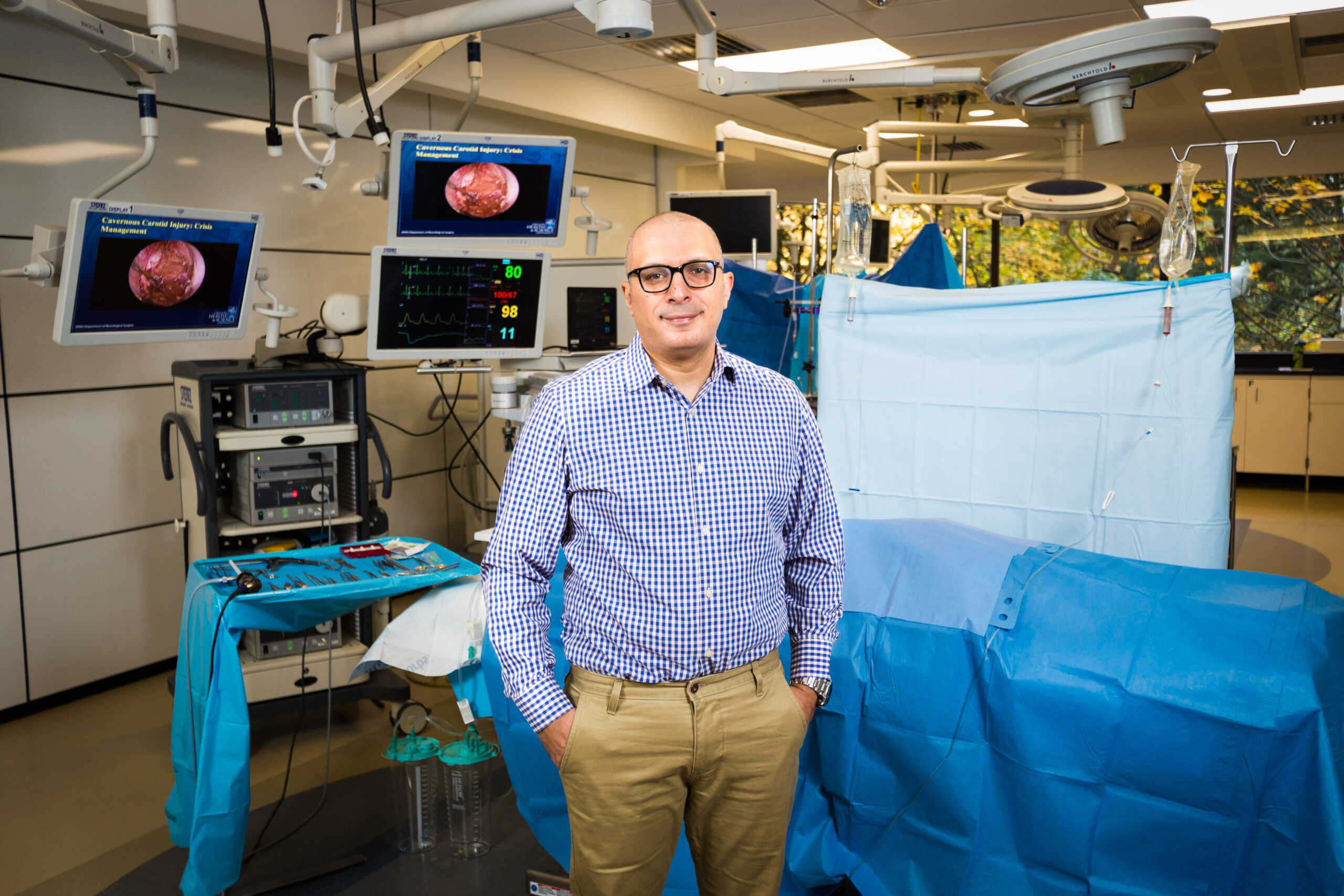
Researchers like OHSU’s Ahmed Raslan, M.D., FAANS, are charting the brain’s landscape in unprecedented detail, yielding fresh insights that could change the field of neuroscience forever.
“We are at the convergence of multiple disciplines that for the first time allows us to get closer to the complexity of the system that we seek to heal and understand,” said Raslan, Raaf Professor of Neurological Surgery and chair of neurological surgery in the OHSU School of Medicine. “This work has the ability to redraw the functional atlas of the brain. Much in the same way we invented high-powered telescopes to examine the lunar surface, we can now do that on the brain.”

Raslan’s work sits at the intersection of surgery and research, and he treats patients with a variety of neurological disorders and diseases, including epilepsy, Parkinson’s and brain tumors. In 2022, his research team developed a sensor grid that records high-resolution maps of the brain. The technology enables a level of precision during brain surgery not previously possible and has been used primarily in patients undergoing surgery for brain tumor removal.

When brain tissue is infiltrated by a tumor, its electrical signal changes, differing from the unaffected tissue. The sensor grid technology precisely detects where those signals differ, allowing surgeons to identify the boundary of that tumor with more accuracy.
So far, mapping the brain in this kind of detail has already produced incredible, lifechanging results. However, scientists believe they’ve only begun scratching the surface of its potential. When leveraged in collaboration with other innovations in neuroscience — like Raslan’s leadership in the development of high-frequency focused ultrasound — the possibilities are vast.
“That’s the value of this high-resolution mapping,” Raslan said. “You could take that and apply it to many other conditions. Parkinson’s. Epilepsy. Chronic pain. OCD. Depression. Post traumatic stress disorder. There will be multiple uses, and the next generation of devices will tremendously benefit humanity as a whole.”
Discovery
Explain It! Jonah Sacha, Ph.D.
Explain It! showcases the fascinating, impactful research at OHSU. Jonah Sacha discusses why he believes we will cure HIV within our lifetimes.
Discovery
Explain It! Kerri Winters-Stone, Ph.D.
Explain It! showcases the fascinating, impactful research at OHSU. Kerri Winters-Stone explains her work and why she believes exercise is medicine.
Discovery
High resolution healing
Innovative sensor technology sheds new light on brain structure and transforms neurosurgery.