


By Darby Kendall
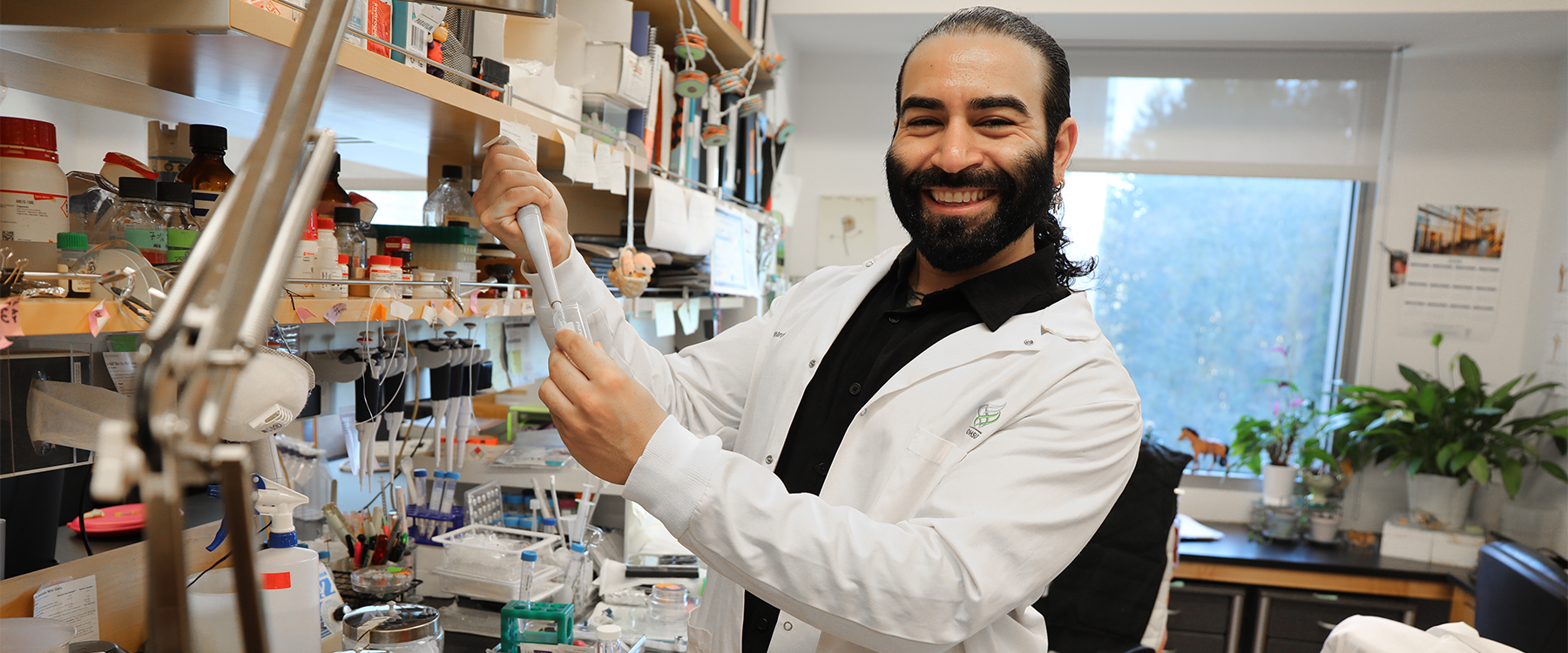
In the field of scientific research, there are two distinctly different types of labs: wet and dry. Wet labs focus on material experimentation and hands-on learning, while dry labs deal with computational and theoretical research. Combining the knowledge from both types of labs can lead to exciting innovations. Bridging those two worlds, however, can prove challenging.
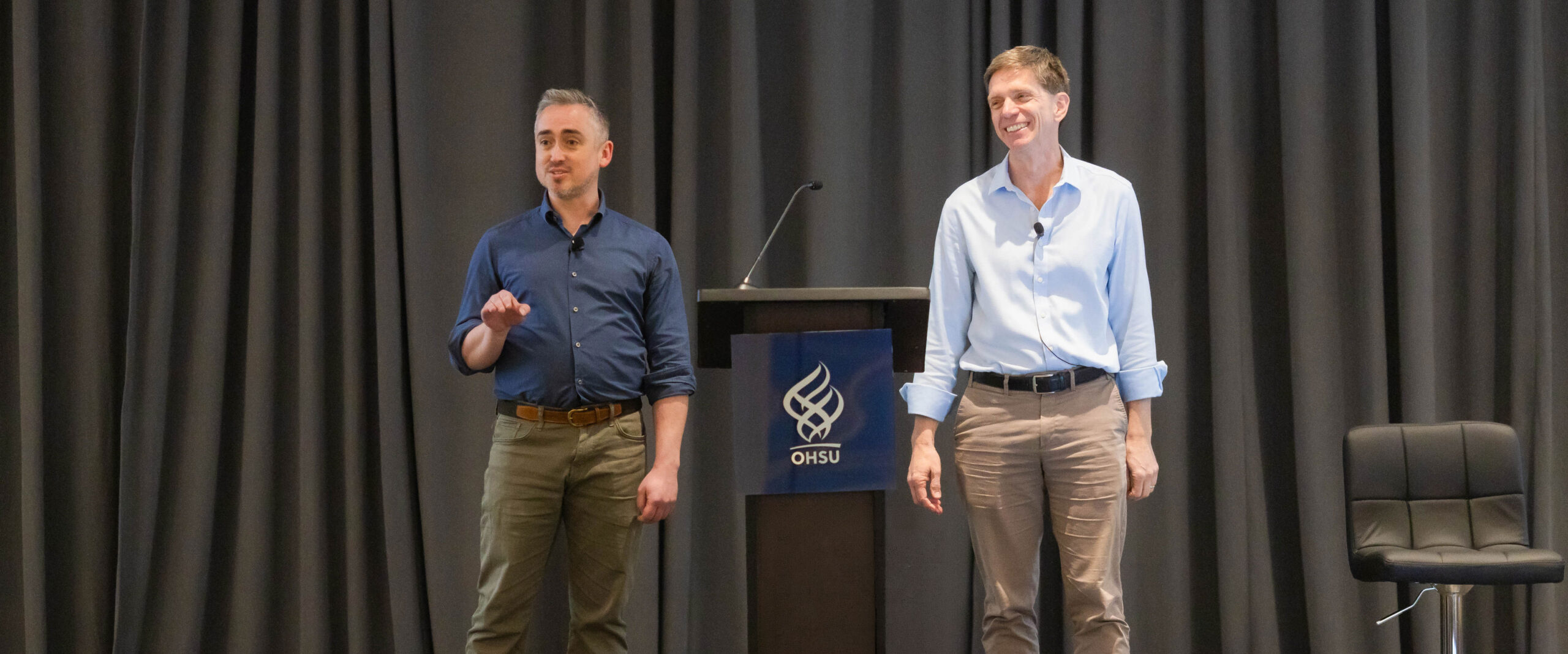
Collaboration is key, and Katie Blise, Ph.D., and Sam Sivagnanam, M.S., have been meeting in the middle since 2018 with exciting results.
Blise and Sivagnanam, computational biologists at the OHSU School of Medicine with affiliations in the Brenden-Colson Center for Pancreatic Care and the Cell, Developmental and Cancer Biology departments, are developing new software that helps scientists quickly visualize and interpret large datasets. Thanks to advancements in technology over the past decade, scientists now have the ability to deeply analyze the cellular composition of diseased tissues.
“If you have a tumor sample like a biopsy, researchers can assess those tumors and tell you every cell that’s present. Are they cancer cells? Are they immune cells? The data holds what their functions are and how they’re all spatially oriented to each other,” Blise said. “All of that information is relevant for treatment and progression of the tumor, how aggressive it might be, what types of therapies a patient might respond better to versus not, and overall clinical outcomes.”
However, the data generated from these assays can be large and unwieldy, leading to challenges in making sense of results. Blise and Sivagnanam’s software removes technical barriers for researchers, empowering them to conduct analyses on data that could otherwise take thousands of dollars and several months to go through.
“We are at a point in research where we are generating way more data than humans alone can analyze. We need computers to help us integrate all of this information,” Sivagnanam explained. “Katie and I are biologists that have programming skills, so we write code and design analysis to help make sense of all the data that wet labs and dry labs are both producing.”
The two were named New Innovators of the Year at the 2025 OHSU Innovation Awards for their software tool and its potential to create tangible solutions for patients battling a variety of diseases. Currently, Blise and Sivagnanam are focused on the application for cancer patients, as large datasets generated by precision cancer researchers are increasingly common in the field.
“We are at a point in research where we are generating way more data than humans alone can analyze. We need computers to help us integrate all of this information.” – Sam Sivagnanam
Along with winning the New Innovator Award for their work, Blise and Sivagnanam also received a grant from the Biomedical Innovation Program in 2024 to further advance their software and take it to market. Both are grateful for the significant support, as they are eager to see their software make it into labs and assist scientists around the globe.
“Winning this award will ultimately make our tool accessible to others and get it out of our hands and into the world,” Blise said. “Knowing that we have this award also shows that we have the support of people at OHSU.”
Added Sivagnanam, “It’s been nice to have this kind of trust and support so that we are able to pursue bold ideas and actually make them a reality.”
Collaborative connection
Sivagnanam and Blise first met at OHSU seven years ago and have been consistent collaborators ever since. Blise expressed that she’s grateful to have Sivagnanam to bounce ideas off of and check conclusions when combining experiment results with her computational work.
“It’s great to have someone who speaks the same language,” agreed Sivagnanam. “There are a lot of niche terms, and the data analyses themselves are complex. To have someone that understands how the data was generated and then be able to talk about how it should be analyzed in the context of tumor biology, has really helped us move quickly and make a lot of progress.”
OHSU’s research structure has also benefited Blise and Sivagnanam with its cooperative nature. The existence of countless areas of disease research along with wet and dry labs has provided the two with ample data to work with while developing their software.
“I think that science is moving in the direction of team science. We need to be collaborating,” Blise reflected. “The fact that at OHSU we have labs that are at both ends of the spectrum — those that generate the data in experiments and those who analyze it — and also have labs in between, helps the collaboration happen quickly.”
The next step for the pair’s software is to put it on the cloud, making it accessible to all who need it. Historically, this type of data analysis has required computational hardware and advanced computing, limiting its use. By using the cloud, scientists will be able to simply log onto a browser and access the tool, leading to more patients ultimately being helped.
“We’ve already had exciting data come out of it, where it took us a couple of hours to analyze something that, prior to this, would have taken months to get to,” Sivagnanam said. “To imagine scientists and doctors being able to quickly open the tool and find a meaningful result that is clinically translatable is really exciting. We’re excited to accelerate research in this field and ultimately make a positive impact on patient care.”
Support the OHSU Innovates IDEA Fund

Discovery
Discovery
Discovery